Configurators
How to build a motorhome configurator
Open the option grid your network sends buyers today. Count the combinations that can actually be built. You have just measured the gap between what your range allows and what a buyer manages to picture: that gap is exactly what a configurator closes.
By Wake Systems··10 min read
What a motorhome buyer looks for online
The purchase turns on two questions, and they arrive in this order. What does the vehicle look like once equipped the way I want it, and what exactly does it cost like that.
On a forecourt, the answer depends on what happens to be in stock that day. Online, it depends on the website. A buyer torn between two layouts and three colours moves from page to page, mentally assembles photographs taken on different vehicles, and ends up asking the dealer to redo the sums by hand.
A configurator brings both answers to the same place at the same moment. The buyer chooses, the vehicle redraws, the price follows. That is what separates a configurator from an online catalogue: the answer arrives while the question is still being asked.
The configurator picks up the option grid
The starting point is already in your hands. It is the network's option grid, with its layouts, exterior finishes, upholstery lines, energy packs and awnings, and the vocabulary dealers use on the phone.
That document does two things at once: it lists what exists, and it carries, often in footnotes, the rules that say what goes with what. The first part reads easily. The second lives in the heads of experienced salespeople.
Picking that document up as it stands, vocabulary included, is what makes a configurator immediately legible to the network. A buyer who then calls their dealer uses the same words, and the conversation starts in agreement.
Compatibility rules do the real work
A motorhome range is a matter of combinations. Four layouts, a dozen colours, two upholstery lines, a solar pack, an awning and a list of options quickly produce tens of thousands of theoretical vehicles, only some of which leave the workshop.
The underlying work is therefore to turn assembly rules into something the configurator applies live. An option incompatible with the chosen layout simply stays off the screen, and the buyer moves through a space where every path ends in a buildable vehicle.
It also changes the nature of incoming orders. The network receives configurations that can be ordered as they stand, rather than requests to be picked apart one by one.
A price that follows every choice
The permanently visible price is the second half of the promise. Chassis, layout, equipment packs, individual options: every click updates it, and the buyer sees what the finish they are hesitating over actually costs.
That transparency has a counter-intuitive and very clear effect. The finishes buyers used to hesitate over become the ones that sell, because the price difference appears at the precise moment the desire forms, and it is often smaller than imagined.
Keeping the price in view at all times, including on a phone screen in the middle of a show, is a design constraint to set from the start. It decides part of the layout.
Images or 3D: what a motorhome needs
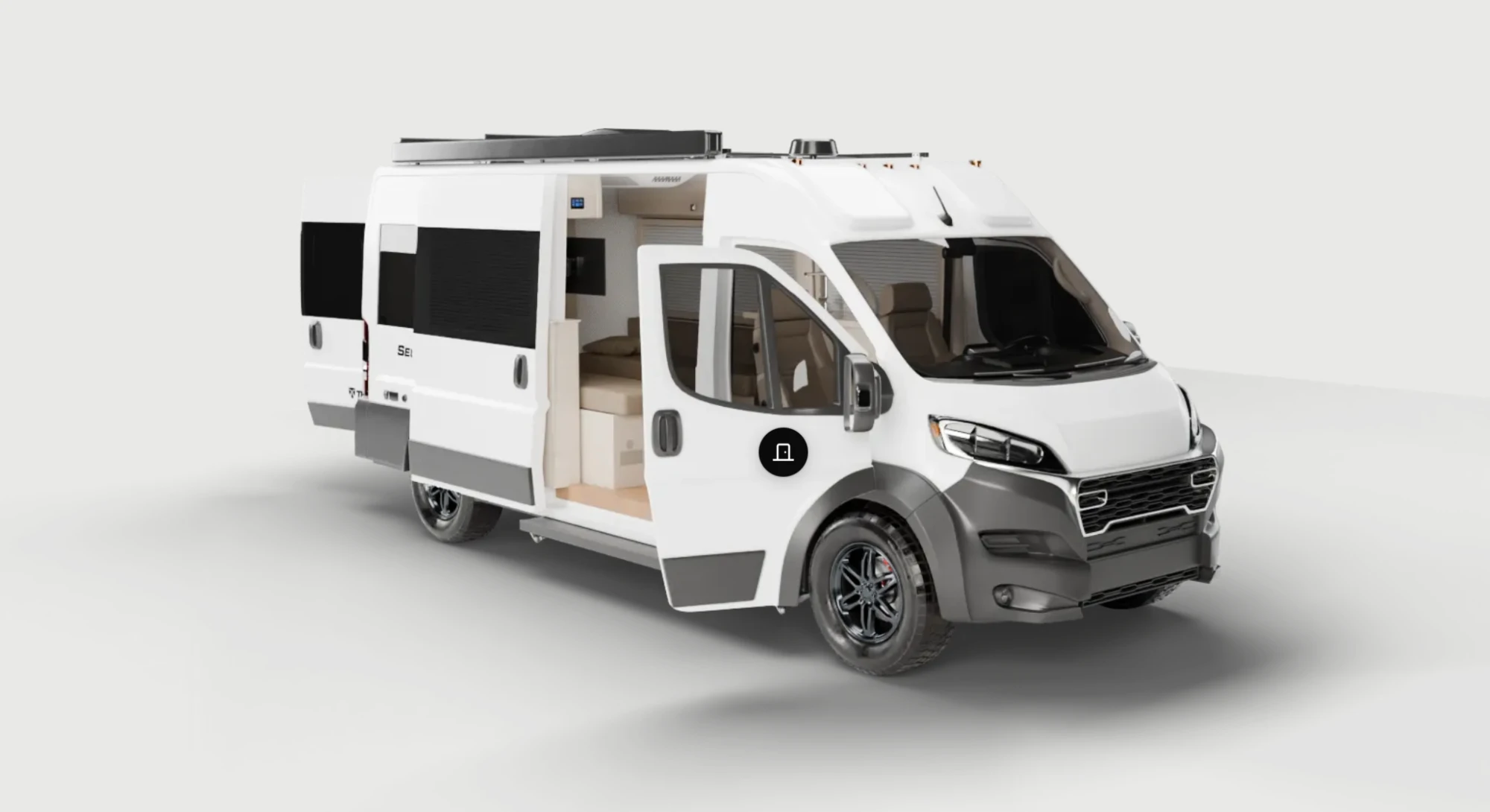
A motorhome is looked at from a few well-chosen angles: front three-quarter, profile, rear with the doors open, and the interior per layout. Those views cover nearly everything a buyer wants to check.
From there, two routes exist. A three-dimensional render the buyer spins freely, or a set of image layers stacked to form the chosen view in the chosen colour. The second route fits in a few dozen kilobytes per view and appears instantly on a phone, which matters as much as realism when the browsing happens standing on a stand.
The choice therefore rests on real use rather than technology. A stable range, looked at from known angles, suits layers very well. A product the buyer wants to inspect freely calls for 3D.
To settle the two approaches: 2D or 3D configurator, what actually changes
What the dealer network gets out of it
The configurator lives on the manufacturer's website, and it is the network that collects most of the benefit. At the end of the journey, the configuration becomes a sheet sent to the dealer the buyer picked.
The salesperson therefore receives a defined, priced, buildable vehicle, along with the context: the buyer's hesitations can be read in what they kept. The meeting starts where it used to end.
At a show, the same tool doubles as a sales aid on the stand. The visitor builds their vehicle with the salesperson beside them, leaves with their configuration, and finds it again at home.
Bringing three dealers into testing before launch is well worth the time it takes. Their corrections land on decisive details: fewer steps, bigger colour chips, the price always in sight.
Timeline and budget for a motorhome configurator
The schedule splits into three fairly stable stages. Translating the option grid and the compatibility rules, producing the views and layers, then assembling the journey and the pricing.
The first two depend on the material you already hold. A documented range and available design files shorten the work noticeably, since views are produced from what exists rather than from a full photo shoot.
The budget follows the same logic: it rests mostly on the number of views and the complexity of the rules, far more than on the number of options. Adding a colour costs little. Adding a layout, which needs its own set of interior views, costs more.
The sign that a configurator works
One indicator is enough to judge: the share of enquiries reaching the network as a complete configuration rather than an open question.
When that share rises, everything else follows. Salespeople spend their time on sales instead of quotes, orders go into production without back and forth, and buyers walk into the dealership already knowing what they want.
It is also the measure that says when to stop adding features. The day that share plateaus, the room for progress lies somewhere other than the configurator.